
HORIZON AND LINE OF SIGHT
How Far Can the Human Eye See?
On flat ground or at sea, the human eye can see about 3 miles before the curve of the Earth hides the surface. So how far can the human eye see in total? Much farther, if you are high up or the target is tall or bright. Enter your eye height below to get your own distance to the horizon.
With or without refraction · Line of sight · Hidden height
Calculate Your Horizon
How far is the horizon?
For an eye height h above sea level on a smooth Earth of radius R, the distance to the horizon is d = √(2Rh + h²). A handy rule: d (km) ≈ 3.57 × √h (m), or d (miles) ≈ 1.22 × √h (ft). Air bends light slightly downwards, which usually adds about 7%: d ≈ 3.83 × √h (km) with the standard refraction coefficient k = 0.13.
| Viewpoint | Eye height | Horizon (geometric) | With refraction |
|---|---|---|---|
| Standing, eyes at 5 ft 7 in | 6 ft (1.7 m) | 2.9 mi (4.7 km) | 3.1 mi |
| Two-storey window | 20 ft (6.0 m) | 5.4 mi (8.7 km) | 5.8 mi |
| Lighthouse lamp | 98 ft (30 m) | 12.1 mi (19.6 km) | 13.0 mi |
| Eiffel Tower top | 984 ft (300 m) | 38.4 mi (61.8 km) | 41.2 mi |
| Small plane at 3,000 ft | 2,999 ft (914 m) | 67.1 mi (107.9 km) | 71.9 mi |
| Airliner at 35,000 ft | 35,000 ft (10,668 m) | 229.2 mi (368.8 km) | 245.6 mi |
Line of sight between two heights
Two objects can just see each other when the distance between them is no more than the sum of their horizon distances: d = √(2Rh₁) + √(2Rh₂). A 30 m lighthouse can be seen by a sailor whose eyes are 3 m above the water from about 26 km (16 mi) away, ignoring haze.
Hills, buildings, haze and weather often limit what you can see long before the horizon does.
More distance tools
- Distance as the crow fliesStraight-line distance between any places, with bearing, midpoint and road comparison.
- Google Maps distancePaste Google Maps links or plus codes; step-by-step guide to Google’s ruler.
- How far am I from…Distance from your location to a state, state line, country, city, beach or home.
- Distance to the coastDistance to the sea from any place, height above sea level and a bulk postcode/ZIP checker.
- Halfway pointMeet in the middle by straight line or equal drive time, with cafés and towns nearby.
- Radius mapDraw a circle of any radius, list the towns inside it and see how far it really is.
- Air milesGreat-circle flight distance between airports, multi-leg, with flight time.
- Distance between coordinatesLatitude/longitude in decimal, DMS, UTM; formulas and code snippets.
- Distance between addressesStreet addresses, postcodes and ZIPs; driving mileage and cost.
- Distance between two pointsThe distance formula in 2D and 3D with step-by-step working and a graph.
- Miles ↔ kmLength, speed and running-pace conversions.
2.9 mi
to the sea horizon with eyes 5 ft 7 in up
443 km
photographed from the Pyrenees to the Alps
8%
extra distance from normal refraction
1.6 mi
to see a candle flame on a dark night
The Short Answer
There is no single number, because the answer depends on what you are looking at.
| What you are looking at | How far you can see it |
|---|---|
| The horizon at sea, eyes 5 ft 7 in (1.7 m) up | About 2.9 miles (4.7 km) |
| A candle flame on a dark night | About 1.6 miles (2.6 km) |
| A mountain from another mountain | Over 300 miles (493 km) in the record photo |
| The Andromeda Galaxy | About 2.5 million light-years |
The first row is a limit set by the Earth. The second is a limit set by your eye. The last two show what happens when neither gets in the way.
How to Use the Horizon Calculator
- Enter your eye height. Use your height above the ground or water, in feet or meters. On a balcony or a hill, add that height to your own.
- Choose refraction on or off. Leave it on for a real-world estimate. Turn it off for the pure geometric figure.
- Read the distance. The result is how far away the horizon is from where you stand.
- Add a target height if you have one. The calculator then tells you how far away a lighthouse, ship or tower of that height stays in view.
How Far Can You See to the Horizon?
The Earth curves away from you in every direction. The point where the surface drops out of view is the horizon, and its distance depends only on how high your eyes are.
The Quick Formula
Take the square root of your eye height in feet and multiply it by 1.22. The result is the distance to the horizon in miles. In metric, multiply the square root of your height in meters by 3.57 to get kilometers.
For eyes 5 ft 7 in above the water, that gives 1.22 × √5.58, or about 2.9 miles. The calculator uses the full formula, d = √(2Rh + h²), where R is the Earth’s radius of 6,371 km and h is your height.
Refraction Adds About 8%
Air bends light slightly downward, so you see a little way around the curve. Under standard conditions the horizon is about 8% farther than the geometry says. San Diego State University’s refraction notes give the adjusted rule as roughly 1.32 × √h miles, with h in feet. The calculator can show the result with or without refraction.
Horizon Distance by Height
Height helps, but less than most people expect. Because of the square root, you must go four times higher to see twice as far.
| Where you are | Eye height | Horizon | With refraction |
|---|---|---|---|
| Standing on a beach | 5 ft 7 in | 2.9 mi | 3.1 mi |
| Second-floor window | 20 ft | 5.5 mi | 5.9 mi |
| Ten-story building | 100 ft | 12.2 mi | 13.2 mi |
| Tall skyscraper | 1,000 ft | 38.7 mi | 41.7 mi |
| Mountain summit | 10,000 ft | 122 mi | 132 mi |
| Cruising airliner | 35,000 ft | 229 mi | 247 mi |
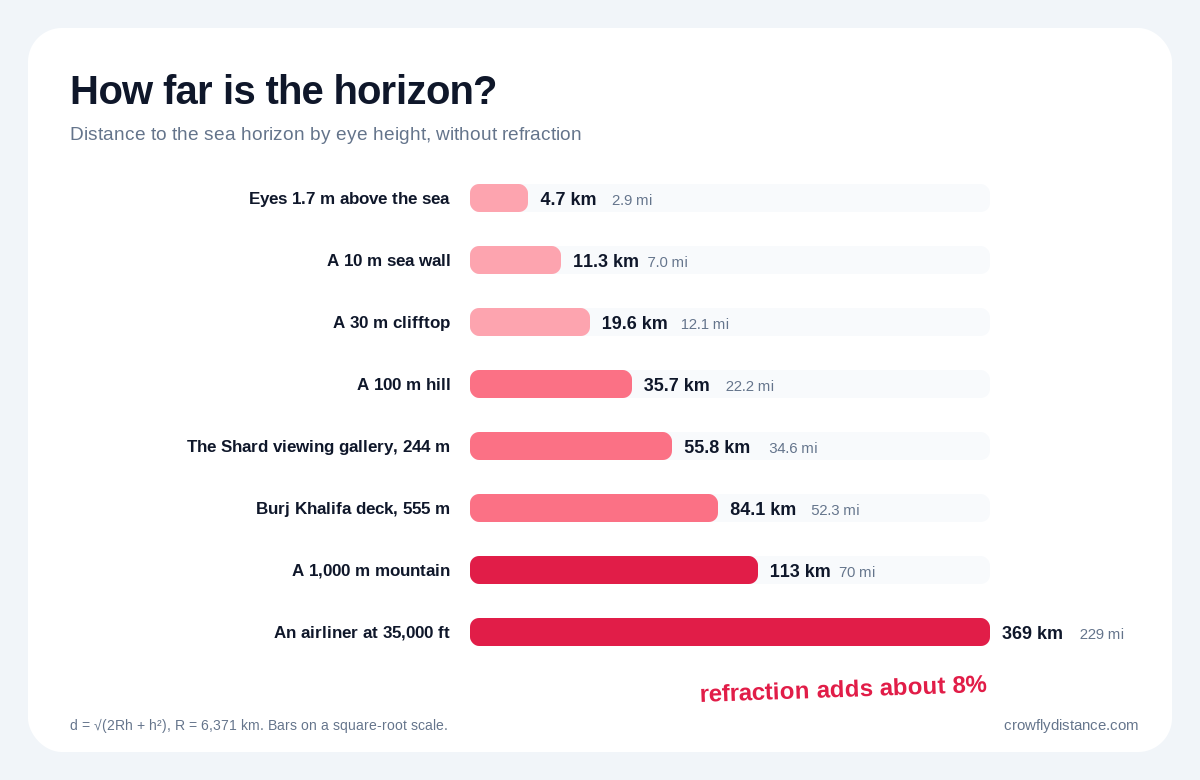
These figures come from the formulas above. They assume a smooth surface such as open sea, with nothing in the way.
How Far Can You See on the Ocean?
Standing at the water’s edge, you see the surface of the ocean out to about 3 miles. That is why a swimmer or a small boat disappears so quickly.
Taller things stay visible beyond that, because their tops rise above your horizon. To find the range, add your horizon distance to the target’s. From the beach, the top of a 100-foot mast is visible at about 2.9 + 12.2 = 15.1 miles, although the hull is hidden long before that. Sailors call this seeing a ship “hull down”.
Can You See 2, 20, 50 or 100 Miles Away?
Yes to all four, given enough height. This table shows how high your eyes must be for the horizon itself to reach each distance.
| To see the horizon at | Eye height needed | With refraction |
|---|---|---|
| 2 miles | 2.7 ft | 2.3 ft |
| 20 miles | 267 ft | 230 ft |
| 50 miles | 1,667 ft | 1,435 ft |
| 100 miles | 6,667 ft | 5,739 ft |
You need less height if the thing you are looking at is tall. A mountain 50 miles away can be in plain view from sea level, because its summit stands far above your horizon.
What Limits the Eye Itself?
The horizon is only one limit. Your eye sets two more: how small a detail it can separate, and how faint a light it can detect.
Detail
An eye with 20/20 vision separates details about one arcminute apart, which is one sixtieth of a degree. At that limit a 6-foot person shrinks to a single dot at about 3.9 miles. You could still notice the person as a speck against a plain background, but you could not tell which way they were facing.
Brightness
A light is easier to see than an object, since it only needs to be detected, not resolved. The popular claim is that a candle flame is visible from 30 miles. Kevin Krisciunas and Don Carona of Texas A&M University tested it in 2015. They found that a candle at about 1.6 miles (2.6 km) matches the faintest stars the unaided eye can see, and that it cannot be seen at 10 miles or more.
The Farthest Thing You Can See
Look up and distance stops mattering. The Andromeda Galaxy is about 2.5 million light-years away, and NASA notes it can be seen with the naked eye. It is the most distant object most people will ever see without a telescope.
How Far Can You See on a Clear Day?
On a clear day the air, not the Earth, usually decides. Dust, moisture and pollution scatter light, and distant objects fade into haze before they reach the horizon. Fog is defined as visibility below 1 km, and even a fine summer day rarely gives a sharp view past a few dozen miles at low altitude.
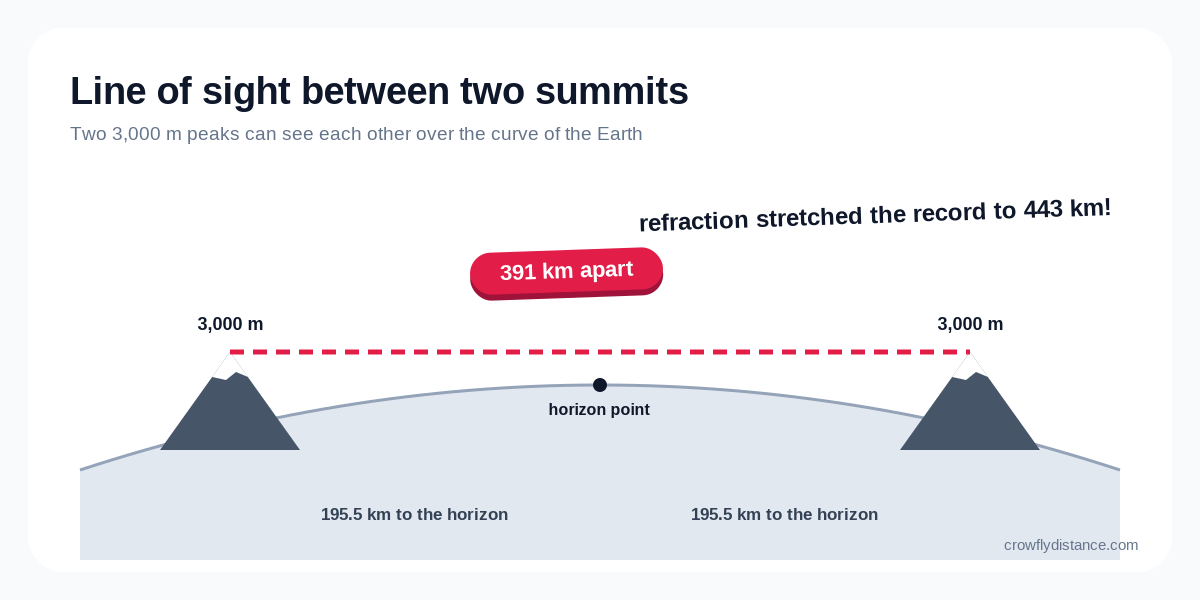
High, dry mountain air is the exception. In 2016, photographer Marc Bret captured Pic Gaspard in the French Alps from Pic de Finestrelles in the Pyrenees, 443 km (275 miles) away. Guinness World Records now lists a longer photographed line of sight of 493 km (306 miles), taken in Turkey in December 2024.
Both shots worked for the same reason. The camera and the target were each thousands of feet up, so the line between them cleared the curve of the Earth.
Line of Sight Between Two Points
To check whether two points can see each other, add the horizon distance of each. Two 100-meter towers each see about 35.7 km, so they can see one another up to about 71 km apart over a smooth Earth.
The calculator’s line-of-sight option does this for you. It also shows the hidden height: how much of a distant object sits below the horizon from where you stand.
Here is an example. From a beach, with your eyes 5 ft 7 in up, anything 10 miles away has its lowest 34 feet hidden by the curve, before refraction. A two-story house on a far shore would be out of sight, while a tall lighthouse would still show its upper half.
Radio waves bend more than light, so engineers place the radio horizon about 15% beyond the geometric one. Add the horizons of both antennas to estimate the range of a VHF or UHF link.
Why Your View May Differ From the Calculator
- Terrain and buildings. The math assumes a smooth Earth. Hills, trees and buildings often block the view first.
- Changing refraction. The 8% allowance is an average. Cold water under warm air can bend light much more.
- Mirages. A superior mirage can lift a distant coastline or ship into view when it should be hidden.
- Contrast and size. An object can be above the horizon and still be too small or too faint to pick out.
Frequently Asked Questions
How far can the human eye see in miles?
About 2.9 miles to the horizon when you stand at sea level, or about 3.1 miles with normal refraction. From a height, or when looking at something tall, you can see much farther.
How far can you see at sea level?
With your eyes 5 ft 7 in above the water, the horizon is about 2.9 miles (4.7 km) away. Sitting in a small boat with your eyes 3 feet up, it drops to about 2.1 miles.
How far can a 6-foot person see?
A person 6 feet tall has eyes about 5 ft 7 in above the ground, so the horizon is roughly 3 miles away on flat ground or at sea.
How far can the human eye see on a clear day?
There is no fixed figure. At ground level the horizon stops you at about 3 miles on flat terrain. From a hill or tower, haze becomes the limit, usually well before 100 miles.
How far can you see from a plane?
At a cruising height of 35,000 feet the horizon is about 229 miles away, or about 247 miles with refraction.
How far away can you see a candle?
About 1.6 miles (2.6 km) on a dark night, according to a 2015 Texas A&M study. The often-repeated figure of 30 miles is not supported.
What is the farthest thing you can see with the naked eye?
The Andromeda Galaxy, about 2.5 million light-years away. It appears as a faint smudge under a dark sky.
MORE TOOLS
Related Tools
Distance to the coast
How far you are from the ocean, with your height above sea level.
Distance between coordinates
The exact distance between two latitude and longitude points.
Radius map
Draw your horizon distance as a circle on a map.
Miles to km converter
Switch any distance between miles and kilometers.
Distance calculator
Straight-line and driving distance between two places.