
MATHS TOOL · 2D, 3D AND POINT TO LINE
Distance Between Two Points Calculator
Find the distance between two points on a graph in 2D or 3D, or from a point to a line. Enter whole numbers, decimals or fractions and get the exact answer in simplest radical form, the decimal value, every step of the working and a graph.
Exact radical answers · Fractions and negatives · Step-by-step working
Calculate the Distance
Point 1
Point 2
Point P (distance from P to the line through points 1 and 2)
Fractions (3/4), negatives and decimals work. For places on Earth, use the coordinates calculator instead — the formula below assumes a flat plane.
The distance formula
In two dimensions the distance between (x₁, y₁) and (x₂, y₂) comes from Pythagoras’ theorem:
d = √((x₂ − x₁)² + (y₂ − y₁)²)
In three dimensions add the z term: d = √((x₂ − x₁)² + (y₂ − y₁)² + (z₂ − z₁)²). The distance from a point P(x₀, y₀) to the line through two points is |(y₂ − y₁)x₀ − (x₂ − x₁)y₀ + x₂y₁ − y₂x₁| ÷ √((y₂ − y₁)² + (x₂ − x₁)²).
Worked example
From (3, 2) to (7, 5): Δx = 4, Δy = 3, so d = √(4² + 3²) = √25 = 5. The midpoint is (5, 3.5) and the slope is 3/4 = 0.75.
This is straight-line (Euclidean) distance on a flat plane. For places on Earth use a great-circle calculation, which accounts for the planet’s curve.
More distance tools
- Distance as the crow fliesStraight-line distance between any places, with bearing, midpoint and road comparison.
- Google Maps distancePaste Google Maps links or plus codes; step-by-step guide to Google’s ruler.
- How far am I from…Distance from your location to a state, state line, country, city, beach or home.
- Distance to the coastDistance to the sea from any place, height above sea level and a bulk postcode/ZIP checker.
- Halfway pointMeet in the middle by straight line or equal drive time, with cafés and towns nearby.
- Radius mapDraw a circle of any radius, list the towns inside it and see how far it really is.
- Air milesGreat-circle flight distance between airports, multi-leg, with flight time.
- Distance between coordinatesLatitude/longitude in decimal, DMS, UTM; formulas and code snippets.
- Distance between addressesStreet addresses, postcodes and ZIPs; driving mileage and cost.
- Horizon distanceHow far you can see from any height, and what is hidden by the curve.
- Miles ↔ kmLength, speed and running-pace conversions.
3
ways to measure: 2D, 3D and point to line
2√13
exact answers in simplest radical form
4
steps in the working, shown every time
2
distances: Euclidean and Manhattan
How do you find the distance between two points?
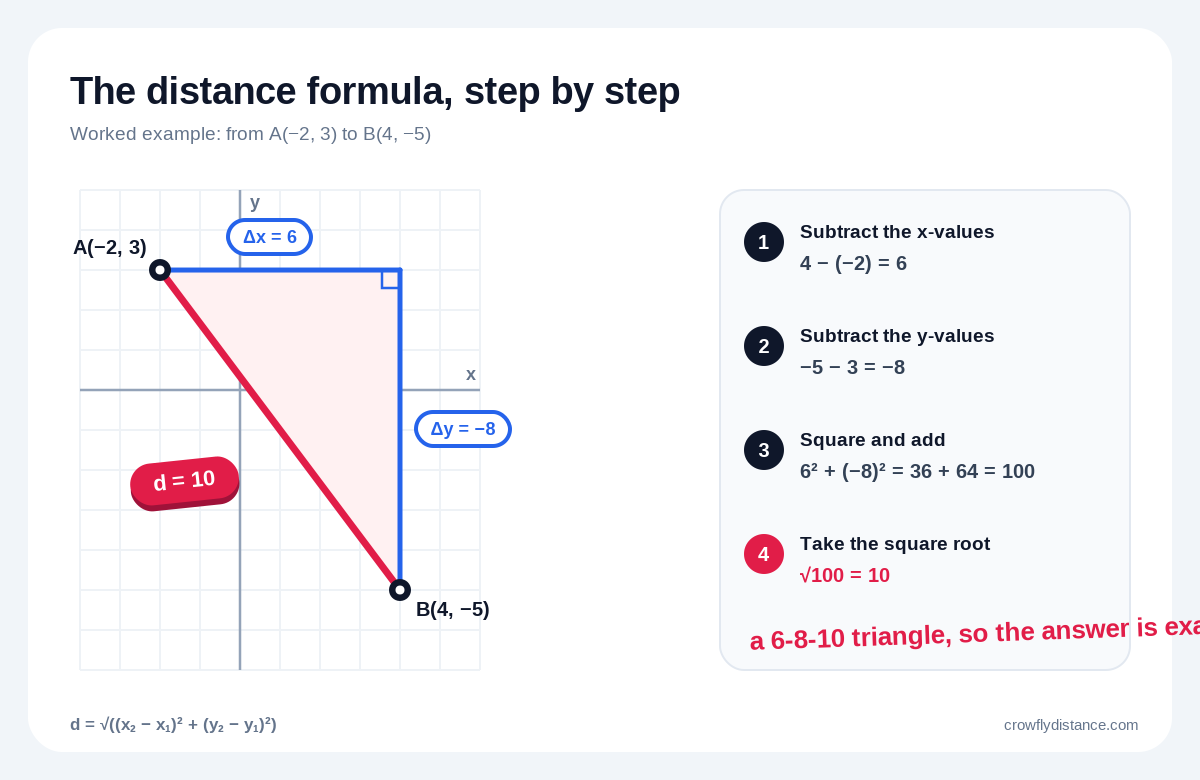
Draw a right-angled triangle with the two points at the ends of the long side. The horizontal side is the difference in x (Δx = x₂ − x₁) and the vertical side is the difference in y (Δy = y₂ − y₁). By Pythagoras’ theorem, a² + b² = c², so the distance is:
d = √((x₂ − x₁)² + (y₂ − y₁)²)- Subtract the x-coordinates and the y-coordinates.
- Square both differences.
- Add the squares.
- Take the square root.
Order and negative numbers
The order of the points does not matter: (x₁ − x₂)² is the same as (x₂ − x₁)², because squaring removes the minus sign. Negative coordinates work the same way: from (−2, 3) to (4, −5), Δx = 6 and Δy = −8, so d = √(36 + 64) = √100 = 10.
Distance from the origin
If one point is the origin (0, 0), the formula shortens to d = √(x² + y²). In 3D it is √(x² + y² + z²).
Exact answers: simplifying the radical
Many distances are not whole numbers, and teachers usually want the exact answer rather than a rounded decimal. To simplify a square root, take out the largest square factor. The calculator does this automatically and shows both forms; when you enter fractions, it keeps the arithmetic exact until the last step.
| Square root | Largest square factor | Simplest form | Decimal |
|---|---|---|---|
| √8 | 4 | 2√2 | 2.8284 |
| √45 | 9 | 3√5 | 6.7082 |
| √50 | 25 | 5√2 | 7.0711 |
| √52 | 4 | 2√13 | 7.2111 |
| √72 | 36 | 6√2 | 8.4853 |
| √98 | 49 | 7√2 | 9.8995 |
TWO KINDS OF DISTANCE
Euclidean vs Manhattan distance
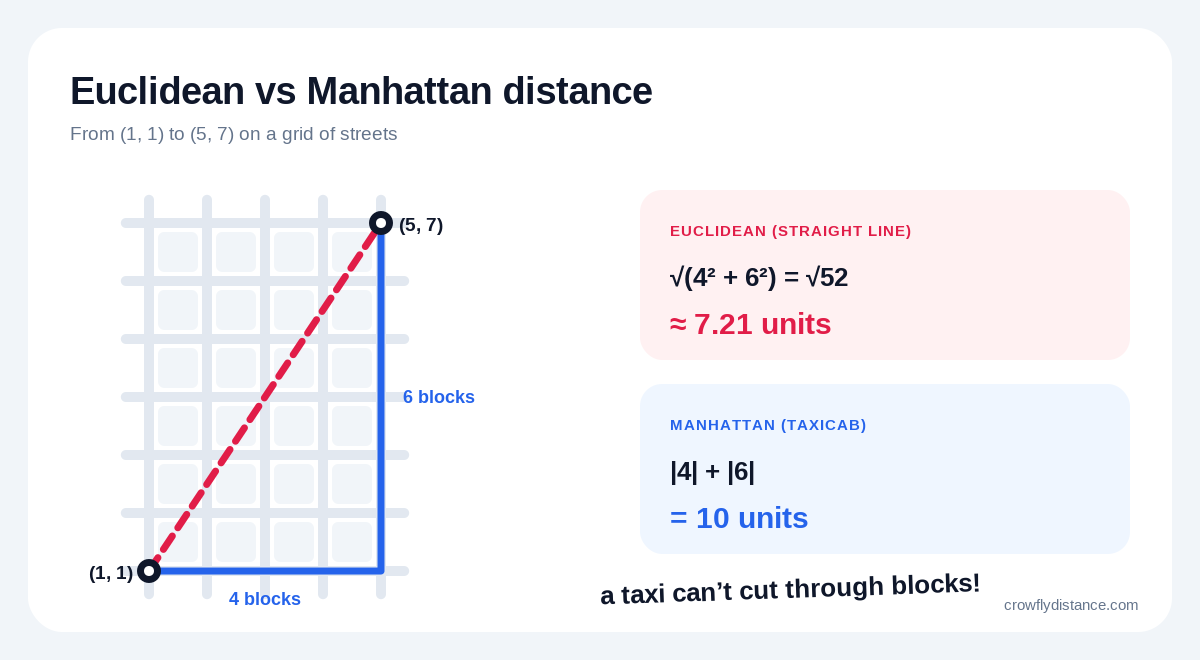
The distance formula gives the Euclidean distance: the straight line between the points. The Manhattan (taxicab) distance is |x₂ − x₁| + |y₂ − y₁|, the distance you would travel along a grid of streets, moving only horizontally and vertically.
From (1, 1) to (5, 7) the Euclidean distance is √52 ≈ 7.21, while the Manhattan distance is 4 + 6 = 10. The calculator shows both.
Distance in 3D, to a line and to a plane
The same idea, the shortest straight line, works in more dimensions and for lines and planes.
Two points in 3D
Add the z-difference inside the square root.
d = √(Δx² + Δy² + Δz²)Example: (1, 2, 3) to (4, 6, 15) gives √(9 + 16 + 144) = √169 = 13.
Point to a line
The shortest distance is along the perpendicular. For the line ax + by + c = 0 and point (x₁, y₁):
d = |a·x₁ + b·y₁ + c| ÷ √(a² + b²)Example: (3, 4) to 3x + 4y − 10 = 0 gives |9 + 16 − 10| ÷ 5 = 3.
Point to a plane
For the plane Ax + By + Cz + D = 0 and point (x₁, y₁, z₁), measure along the normal:
d = |A·x₁ + B·y₁ + C·z₁ + D| ÷ √(A² + B² + C²)A line parallel to a plane is the same distance from it everywhere, so any point on the line works.
Use the Point to line tab: enter two points on the line and the point P. The calculator finds the line’s equation, the distance and the foot of the perpendicular. For two parallel lines ax + by + c₁ = 0 and ax + by + c₂ = 0, the distance between them is |c₂ − c₁| ÷ √(a² + b²).
Distance between two points on a map
Places on a map
For two real places, use the crow flies calculator: it measures the distance between two points on a map over the curved Earth.
GPS coordinates
For latitude and longitude, the flat distance formula is not accurate. Use the coordinates calculator, which works on the WGS84 ellipsoid.
Google Maps
To measure between two points on Google Maps, right-click, choose Measure distance and click the second point. See our Google Maps guide.
Common mistakes
- Forgetting that a negative difference squared is positive: (−3)² = 9, not −9.
- Subtracting x from y: always pair x₂ with x₁ and y₂ with y₁.
- Taking the square root of each part separately: √(9 + 16) is 5, not 3 + 4 = 7.
- Rounding too early: keep the exact radical until the final answer.
Frequently asked questions
How do you find the distance between two points?
Subtract the x-values and the y-values, square both differences, add them, and take the square root.
What is the distance formula?
d = √((x₂ − x₁)² + (y₂ − y₁)²). It is Pythagoras’ theorem applied to coordinates.
Does the order of the points matter?
No. Squaring the differences removes any minus sign, so you get the same answer either way.
How do you find the distance between two points in 3D?
Add (z₂ − z₁)² inside the square root: d = √(Δx² + Δy² + Δz²).
What is the difference between Euclidean and Manhattan distance?
Euclidean distance is the straight line between the points. Manhattan distance is |Δx| + |Δy|, the distance along a grid.
How do you find the distance from a point to a line?
Write the line as ax + by + c = 0 and use d = |ax₁ + by₁ + c| ÷ √(a² + b²). This is the perpendicular, shortest distance.
What is the distance from a point to a plane?
For the plane Ax + By + Cz + D = 0 it is |Ax₁ + By₁ + Cz₁ + D| ÷ √(A² + B² + C²).
Why give the answer as a radical?
A radical such as 2√13 is exact. The decimal 7.2111 is only an approximation.
How do I find the distance between two points on a map?
Use the crow flies calculator for places, or the coordinates calculator for latitude and longitude. The 2D formula only works on a flat graph.